Australians are increasingly conscious of where the products they buy come from. We look for the green and gold logo, choose locally manufactured goods where possible and support businesses that employ Australian workers.
But what about everything sitting behind those products?
A manufacturer might use Australian steel, employ a local production team and work with Australian suppliers. Yet its sales, inventory, purchasing and production could all be managed through software owned and developed on the other side of the world.
If supporting Australian-made matters, perhaps we should also be thinking about the technology running Australian businesses.
The systems behind Australian manufacturing
Software may not be visible in a finished product, but it plays an enormous role in getting that product made and delivered.
For manufacturers, wholesalers and distributors, business software can connect customer enquiries and quotes with sales orders, inventory, purchasing, production, warehousing and freight.
When those processes are connected, information moves with the order.
Sales can see what's available. Purchasing knows what needs to be ordered. Production knows what needs to be made. The warehouse knows what needs to be picked and shipped. Customer service can see what's happening without chasing another department for an answer.
These systems are part of the infrastructure behind Australian manufacturing - just like machinery, materials, people and transport.
Yet software is rarely part of the conversation when we talk about buying Australian.
There's nothing inherently wrong with overseas software. But global platforms are built for global markets. Australian accounting integrations can be secondary considerations, support may sit in another time zone and product decisions are often made thousands of kilometres away.
The gaps between systems are often the real problem
Many growing Australian businesses don't necessarily have a lack of software. They have a gap-between-the-software problem.
CRM sits in one place. Inventory somewhere else. Purchasing has a spreadsheet. Production has another. Freight is booked through a separate portal. MYOB or Xero looks after the accounts.
Each system might do its job perfectly well.
The problems appear in between.
Someone enters the same information twice. An accepted quote needs to become an order. Stock needs allocating. Purchasing needs to know what's running low. Production needs the latest information. The warehouse needs to know what's ready. Freight needs to be organised.
The more a business grows, the harder those handovers become to manage with spreadsheets, emails and people simply remembering what happens next.
That's where things fall through the cracks - costing businesses time and money and, potentially, damaging customer relationships.
Stuck between spreadsheets and ERP
This leaves many growing manufacturers, wholesalers and distributors in an uncomfortable middle ground.
At one end are spreadsheets. They're inexpensive, flexible and familiar. But as order volumes increase, spreadsheets multiply, information stops matching and more of the business becomes dependent on people knowing what happens next.
Spreadsheets are excellent tools. They just weren't designed to run a connected product-based business.
At the other end is traditional Enterprise Resource Planning (ERP) software.
ERP systems can be enormously powerful, but they can also bring significant cost, complexity, consulting and implementation requirements. For a growing Australian SME, jumping from spreadsheets and accounting software into a large enterprise ERP implementation can be a very big leap.
There needs to be something in between.
An Australian-built ERP alternative
That's the space Tall Emu was built to occupy.
Tall Emu is Australian-owned, developed and supported business software for manufacturers, wholesalers, distributors and other product-based businesses that have outgrown spreadsheets or disconnected systems but don't necessarily need a traditional enterprise ERP.
It's more than a standalone CRM because it connects the customer and sales side of the business with what happens after the order is won.
Tall Emu brings together CRM, quoting, sales orders, inventory management, purchasing, manufacturing, warehousing and freight in one connected platform.
It also provides connections with MYOB and Xero, so businesses can continue using their existing accounting software while Tall Emu manages more of the operational work around it.
A customer enquiry can become a quote and then an order. That order can connect to available stock, purchasing or manufacturing. From there, it can move through the warehouse into picking, packing, freight and delivery.
Instead of people manually moving information between separate systems, the information can move with the work.
Tall Emu also has its own development team, allowing the platform to be customised where a business has requirements outside the standard software - particularly useful in manufacturing and distribution, where the processes that make a business different are often the processes that make it competitive.
Who is Tall Emu designed for?
Tall Emu is designed particularly for Australian and New Zealand SMEs that manufacture, wholesale, distribute or sell physical products.
It's a good fit for businesses that have reached the point where sales, inventory, purchasing, manufacturing and fulfilment can no longer be managed efficiently through separate systems.
That might mean you've outgrown spreadsheets, need CRM and inventory management in the same system, want sales orders connected to stock and purchasing, need manufacturing functionality such as BOMs and Work Orders, or want warehousing and freight connected with the rest of the business.
For businesses already using MYOB or Xero, Tall Emu can add that operational capability without necessarily replacing the accounting platform that already works.
In other words, it's designed for businesses that need more than CRM, more than accounting software and more than spreadsheets - without necessarily needing a massive ERP.
Australian Made is bigger than the finished product
When we think about Australian manufacturing, we naturally focus on what we can see.
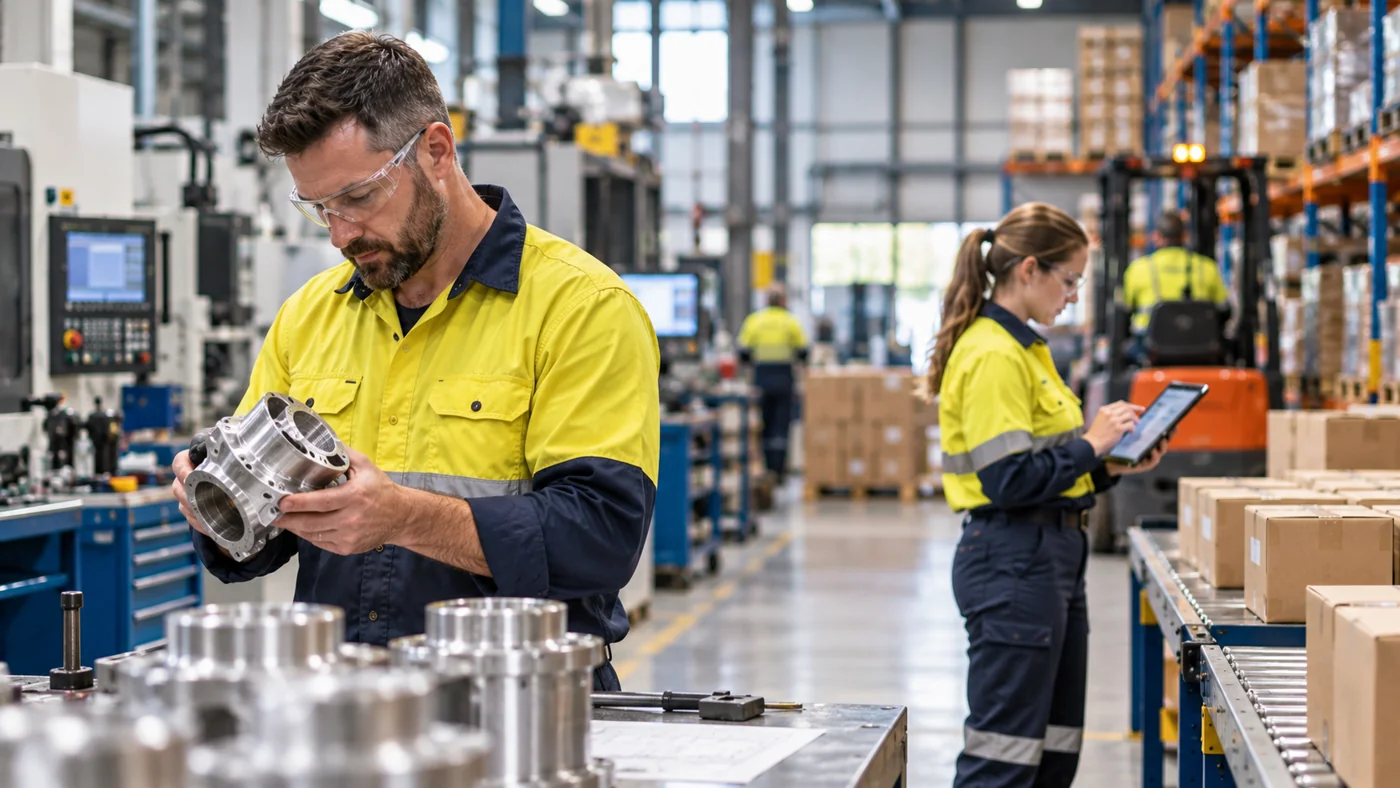
The materials. The machinery. The factory. The people on the production floor. The finished product heading out the door.
But there's an entire layer of technology sitting behind it.
It's managing the customer, the order, the stock, the purchasing, the production process, the warehouse and the shipment.
Supporting Australian industry can mean more than choosing the product made here. It can also mean supporting the Australian suppliers, technology, expertise and jobs that help local manufacturers compete.
Because buying Australian doesn't have to stop with the product that leaves the factory.
Perhaps it's also worth asking:
“What is running the Australian business that made it?”